A couple of months ago, I posted part I of this book’s summary and review. It’s now finally time to finish it in part II. Since it’s been a while, this post begins with a quick recap of the key takeaways from part I.
Recap
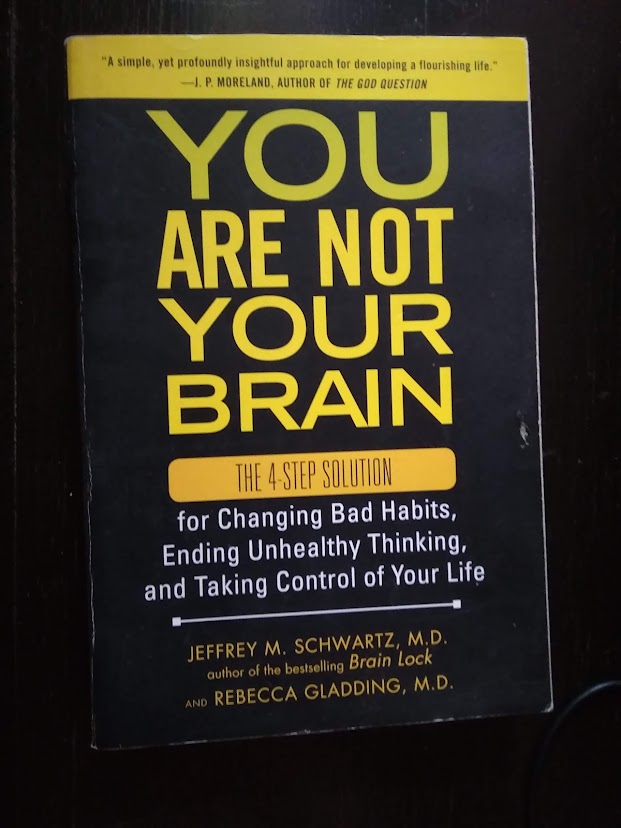
‘You are not your brain’ is a book that offers to the layman a simplified and practical explanation of the human brain, particularly the functions involved in behaviour-formation. It subsequently offers science-backed solutions to “rewire” the brain to work for us, get rid of destructive habits and build new, healthy ones.
The term mind is used for conscious parts of the brain that harbor the perspective of one’s long-term well-being and interests. The term brain describes a more primal, instinct-oriented organ that functions in the “survival of the fittest” mode, processes information in rote, automatic ways, and produces survival-based reactions to the environment. An asymmetry in the roles of the mind and brain can lead to a number of physical and mental health problems.
In modern day life, our primal tendencies manifest in different forms. Our brains often perceive danger and respond with anxiety, over-analysis, panic, and emotional suppression to the sometimes-harmless cues in our social environments.
Deceptive brain messages are the unhelpful, distracting thoughts, urges, and impulses, and desires which take one away from their true goals and intentions in life. While we cannot control the initial appearance of deceptive brain messages, we can use the power of the mind to stop ourselves from acting on them. Many deceptive brain messages originate in our childhoods, are learnt from caregivers or slowly entrench as coping mechanisms against social pain.
David Richo introduced the concept of The 5 A’s: acceptance, affection, appreciation, allowing, as fundamental emotional needs of a person. He recommends seeking not more than 25 percent of these necessities from our relationships with others, and providing the rest for ourselves.
Habits and their formation
A majority of our activities, both physical and mental, are shaped by our habits rather than by conscious, spontaneous decision-making or willpower. The book explains the neurological mechanism behind the cycle that enables the formation and entrenchment of bad habits. When a person is confronted with a psychologically stressful or traumatic situation, the Warning Center of the brain sends false alarms and generates uncomfortable physical and emotional sensations. Further, the Habit centre generates automatic thoughts and actions that seem to be out of one’s control. Other parts of the brain try to calm the Warning Center with unhealthy coping mechanisms (for instance, overthinking, catastrophizing, picking up a cigarette or alcohol, etc.).
Hebb’s law says that when groups of nerve cells (or brain regions) are activatedin the same pattern at the same time repeatedly, they form a circuit and get “locked in” together. In short, Neurons that fire together wire together. This law describes the mechanism in which our behavioural responses become unconscious, hardwired. The crucial step to overcome bad habits consists of separating the conscious, voluntary mental processes from the ones we have no control over.
My addition: Step 0
Having discussed the brain machinery running in the background of our lives in part I, part II of the post talks about the solution the book offers to overcome bad, hard-to-break habits and patterns, i.e. the four steps. Before incorporating these, we also need to apply a step zero, Recognize, which comprises the action of distinguishing between our true needs and the deceptive messages.
Oftentimes, our bad habits become so habitual and automatic that we don’t realize the effect they have on our lives, or connect them to their consequences. For instance, a person who has developed a regular habit of procrastinating their bedtime way too late, may be suffering the consequence of feeling perpetually fatigued and burnt out, but yet not connect this problem to their sleep patterns. Before such a person goes about applying the four steps to solve their problem, it is important for them to recognize the root cause.
This step by itself may take a significant amount of time, reflection and experimentation. It also takes a good amount of effort and practice to sit with one’s feelings, and stop oneself from acting on deceptive thoughts and harmful urges and trying to control them. The one criticism I could offer about this book would be that the authors do not spend sufficient time discussing the work required prior to the four steps.
The Four Steps
The following are the four steps for overcoming the overwhelming effects of deceptive brain messages and rewiring the brain, as offered in the book. The authors describe them accurately as “the wedge between brain’s false reality and the more clearheaded view of your wise advocate”.
-
Relabel. This step involves the identification of brain messages and uncomfortable sensations and calling them what they really are, without judgement. This action creates distance between one’s thoughts and the sense of self, and promotes calmness and straight thinking. Examples of this process are taking mental notes on instances of avoidance when anxious, where one’s attention is usually focused on patterns in one’s running thoughts. The authors emphasize that awareness is an activity.
-
Reframe. This step aims to change one’s perception of the importance of the deceptive brain messages, to acknowledge why they are so bothering and powerful, and to de-personalize them. It insists on thinking of them repeatedly as falsities without trying to suppress them. As we often realize too late, what seems a big deal in the moment is not that important in the grand scheme of life, and acting impulsively on sensations can do a lot of damage. The authors offer concrete methods for reframing:
-
Focus on biology: Involves thinking of one’s impulses, cravings and actions in terms of primal, hardwired instincts.
-
Reframe social pain: Involves a reinterpretation of past socially painful situations. This could also include reflecting on the lack of healthy socialization and one or more of the 5 A’s in one’s life.
-
Reframe thinking errors: The authors talk about thinking errors, which are not actual thoughts but habitual and automatic responses to deceptive brain messages, like irrational “shoulds”, all or nothing, or black and white thinking, “if only” thinking, catastrophizing, exaggerating of present experiences, making irrational predictions, discounting the positive, making faulty comparisons, emotional reasoning, and faulty mind reading attempts.
-
Refocus. This step requires a redirection of one’s attention towards an action or mental activity that’s wholesome and productive, while letting the deceptive brain messages be present. As in many other contexts, hyperfocussing and obsessing with a problem almost always makes it worse and promotes consequences that only create more problems. This is all the more true when it comes to irrational mental patterns, and thus, it is most productive to refocus and “move on with your day”. A refocus activity can be as simple as deep breathing, going for a walk, taking a shower, etc. It is important to note that this is not meant to be a distraction, which still involves “active avoidance”, and thus also thinking about what is being avoided. The authors rightly emphasize the importance of not indulging in mental cravings, especially when they are actively present. As common experience goes, and as the book explains, indulgences soon become habits.
-
Revalue. This final step involves reflection in retrospect, and clearly seeing the thoughts, urges, impulses for what they truly are, and internalizing their insignificance and irrationality. Examples would include reflecting on what is truly driving one’s actions and thoughts, whether patterns in our behaviour like excessive planning, overthinking, avoidance, guilt, shame, etc. are truly necessary or caused by deceptive and harmful brain messages. This is a key step to ingraining new, positive habits and responses, and developing mental resilience against the power of the deceptive brain messages, and eventually, mastering the evaluation of one’s sensations.
Closing remarks and authors’ tips
The authors offer some additional insights and tips on implementing the four steps. They acknowledge that the hardest part is allowing deceptive brain messages to be present without acting on them, while staying with the uncomfortable desire to get rid of them. However, this is perhaps the most important step, because it is essential to developing an objective perspective on one’s thoughts before it is too late. The authors advise to avoid trying to achieve perfection, to accept some bad days, practice gentle observation, journaling, mindfulness and small, gradual changes in behaviour. Indeed, they are quite right that it takes time for a separation between deceptive thoughts and oneself to develop.
One factor that the authors seem to forget to mention is that the implementation of the four steps is a constant, never-ending process. Unfortunately, understanding and overcoming one form of deceptive thoughts does not imply a mastery of all kinds. Life is full of different, changing kinds of stresses, and it is inevitable that changes in our environments lead to new kinds of unhealthy thoughts and cravings for coping mechanisms. It is thus important to regularly reflect on and monitor one’s habits and thought processes, and recognize a problem when it comes up.
Finally, the four steps aren’t magic or a miraculous, shocking discovery. Most people subconsciously at some level use the principles of self-reflection and observation to work on their habits, and realize that they have thoughts and urges that are harmful and need to be ignored. The power of the four steps is that they put together what actually works, and explain the science behind it. While a common person with no knowledge of neuroscience may over time develop an understanding of their behavioural patterns, common sense is less helpful in building up a systematic and scientific process for change. This is the role fulfilled by the book, which is, in conclusion, definitely a recommended read.