My latest language course had an open-ended theme for the presentation to be evaluated as the final exam. I chose to use the opportunity to read a new book, Esther, das Wunderschwein (German translation of Esther the Wonder Pig) and speak about it during my 5-minute presentation.
The original book in English is authored by Steve Jenkins und Derek Walter, and told as a personal story from the perspective of Steve. The German translation is by Caprice Crane. The book tells the story of Steve and Derek, who are a couple from Ontario, Canada, and the unique story of their life together with their adopted pig, Esther.
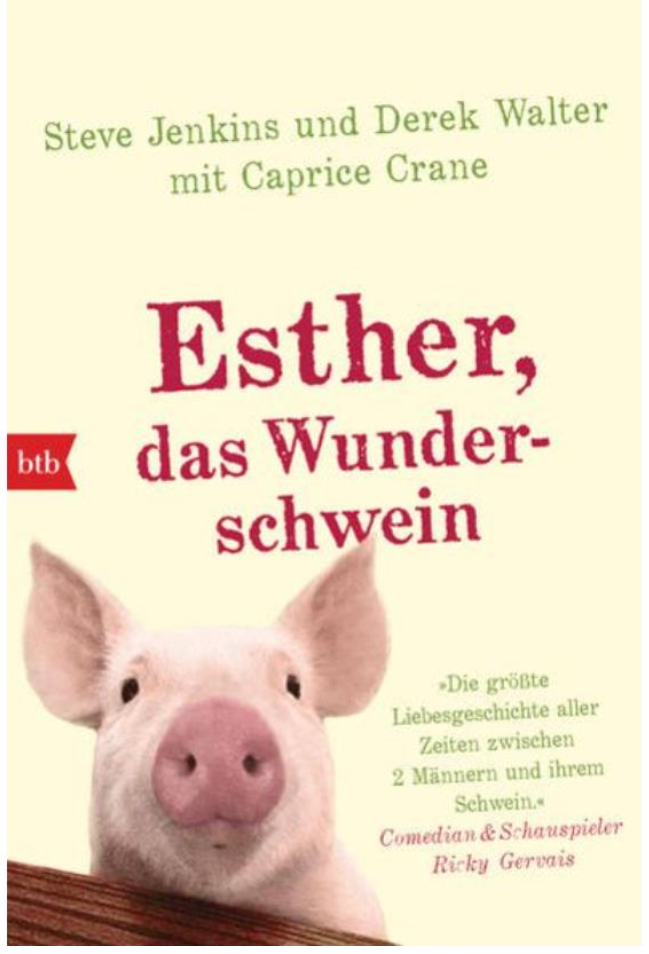
The book begins by delving a bit into the childhood of Steve and his history of love for, and friendships with, non-human animals. Of striking notice is his memory of losing a beloved pet dog to a tragic accident when he was a child, and the unforgettable pain etched in his heart by this incident. The story of Esther begins in 2012, when Steve adopts her from an old acquiantance, thinking her to be a micro-pig. Hereforth, the book narrates the ups and downs, adventures, learnings, and a new unbreakable bond of friendship and love between, the authors and Esther.
Narration
Needless to say, the storyline of the book is unique and intrinsically fascinating. Stories about pets and human-nonhuman relationships themselves often tend to invoke interest and wonder in people; in this case, the reader is all the more enticed to know what it is like to have this very different kind of companion animal at home. Nevertheless, even accounting for its novel facets, this particular story shines and stands out in terms of the narration and characters. The story is gripping, flows naturally, and solicits a wide range of emotions in the reader, including curiosity, laughter, and empathy.
The authors have very different but both very relatable personalities, and the reader quickly finds themselves identifying with each of them. The contrast in personalities, combined with the situations they face, and the author’s comical narration, together render the book a very enjoyable and humorous read. Credit also goes to the translator in maintaining the comic factor in the German version.
Trials and Tribulations
The book maintains a light-hearted tone even when dealing with the more intense, hard times faced by the authors. Indeed, Steve and Derek traverse an arduous and tumultous journey in raising Esther from infancy to adulthood, lacking prior knowledge, experience, and support from others. Despite living already with two dogs and two cats, they soon discover that training and co-living with a rapidly growing pig is a different ballgame altogether. Initially, Steve and Derek are led to believe that Esther is a “Zwergschwein”, or dwarf pig, who wouldn’t grow to be too big. They were eventually proven grossly wrong, when Esther grew to be 300 pounds, which itself proved to be a challenge in their regular-sized home. The support they received from the veterinary doctor .was inadequate. Their families, too, were unhappy with them busying themselves caring for an animal who did not belong in, or deserve, a normal home. Indeed, perhaps the hardest part in their journey was the apathy of the people who told them that pigs were dirty and meant only to be used and eventually slaughtered [“Nutztiere” directly transates to “use-animals”].
Newfound perspectives and a friend for life
Despite difficulties, the authors’ lives were touched and transformed more than they had ever imagined. For the first time, they learned about the behaviour, sharp intelligence, quirks, and friendship of a pig. They saw how similar Esther was to the dogs and cats that they loved so much, and were soon equally in love with her, and willing to do all they could to protect and nurture her. Esther was fun-loving, jovial, friendly, and affectionate. She had a lovely “smile”, which was one of the first things Steve noticed in her when he brought her home. She played with the same toys that the dogs played with. As a child, she loved to sit in the authors’ laps and rub her head or snout with their hands. She loved attention and wanted to cuddle whenever she was tired. She also formed frienships with the cats and dogs of the house. She had her own unique and quirky personality and did something new and interesting everyday.
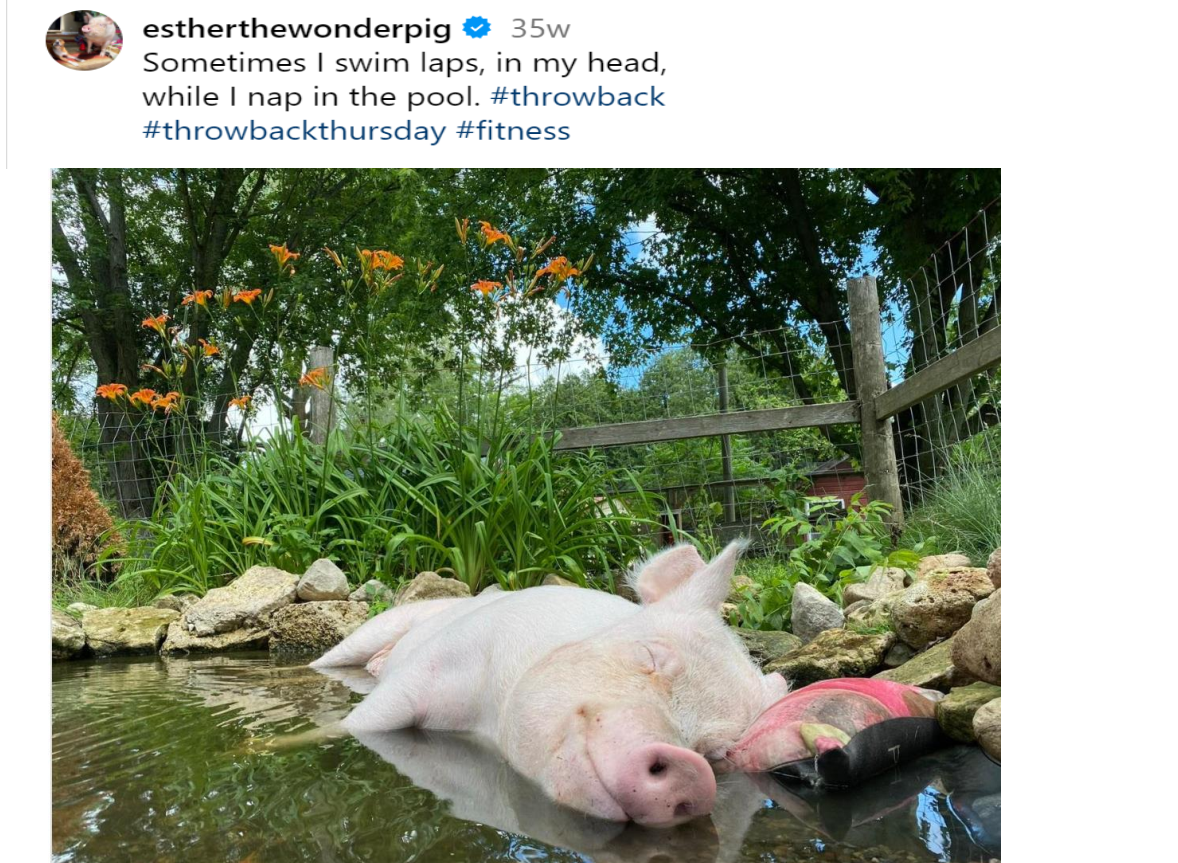
The authors eventually started a Facebook page “Esther the Wonder Pig” to share the story and daily adventures of Esther. Here, they uploaded adorable photos and videos of Esther, along with humorous captions, and brought her amusing personality to the world. To their initial surprise, this page soon gathered a large number of fans, who devoured updates on the life and shenanigans of Esther and of her two dads. Today, this page has 1.5 million followers, while her Instagram page @estherthewonderpig has 575,000 followers. The encouragement and support the authors received from these social media pages played a key role in motivating them to continue their work, spread their message, and in inspiring them to bring safety and joy to the lives of other Esthers out there in the world.
Happily Ever Esther Farm Sanctuary
The authors soon saw their lives undergoing more drastic transformations. They soon realized that they wanted not only to share their and Esther’s story with others, but also to actively play their part in changing the world for the better. When Esther grew to be an adult, they decided to move to a farm in order to have enough space for her, and also for more animals that they wanted to rescue. They visited several farms, and finally found one which seemed ideal for their purpose-but it costed 400,000 dollars, which was far beyond their budget. However, almost miraculously, they managed to raise the amount through a fundraising campaign, with the support of their online fans and supporters. Thus came into being Happily Ever Esther Farm Sanctuary.
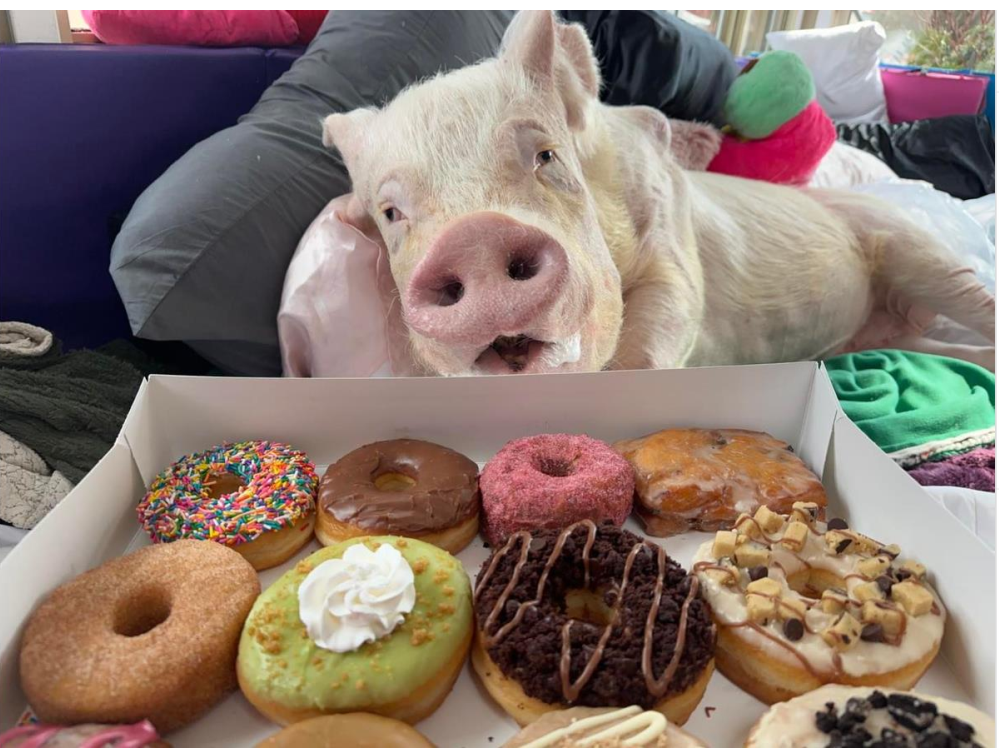
Of course, this sanctuary is in Canada, far out of my reach for the moment, but in passing, as I did during my presentation, I mention a similar and equally lovely such santuary, Hoff Narr, in Zürich, which I have visited more than once.
On October 18, 2023, less than three months ago from now, Esther, aged 11, lost her life to breast cancer, leaving her parents and hundreds of thousands of her admirers heartbroken. To quote their official statement,
There’s no easy way to say this, but the day we all wished would never come has arrived. Esther has passed away. She was calm and peaceful, and fell asleep with her dad Steve by her side…..
Even though Esther is no longer physically with us, her memory and legacy will live forever. Esther is immortal, and we will continue to show the world that all animals deserve to be loved just like she was.
Of the many media articles covering the story of Esther after her death, this one was my favourite: https://www.vox.com/future-perfect/23940933/esther-the-wonder-pig-meat-factory-farming-rescue
Esther was first diagnosed with breast cancer in 2017, but had successfully fought against it and recovered. However, she faced other health issues too, later suffering froma severely painful stomach ulcer which limited her mobility. Indeed, while Esther was fortunate enough to have a life of freedom, care and love, thousands of years of selective breeding optimized towards minimum mobility and resistance and maximal meat output post slaughter, render pigs like her a painful and constricted life, and a shortened healthy lifespan. In fact, most pigs raised for meat are slaughtered at less than one-twentieth the age Esther lived up to, merely at the five to six months, when they are still infants.
Esther’s legacy, message of the book
Although the story of Esther and her two dads is interesting, entertaining, and often hilarious, it carries an important message for the whole world, and a legacy that will remain for time immemorial. Despite being pre-destined for a life of confinement, suffering, and abuse, to end tragically only by slaughter, Esther’s change of fortune allows her to defy these odds to live a happy and free life, and become a much-needed face for “farm/agricultural” animals everywhere. The book, without a touch of preachiness or sanctimony, makes, in the most natural way, a no-brainer case for the cessation of consuming animals and their products, and for a vegan future for humanity.
Needless to say, the authors could no longer consume pork or bacon shortly after they adopted Esther. Soon, they began to also question their consumption of other animal products, leading to a journey of research, reflection, and reconsideration, culminating in a decision to become vegans. As avid meat-eaters who disliked all vegetables and knew nothing about plant-based food or its preparation (unfortunately, at first the only “vegan” food they could name, apart from vegetables, was Quinoa!), the journey was not straightforward for Derek and Steve. Nevertheless, like for most other vegans, it led to them undoing previous conditioning, relearning about food, cooking, and nutrition, and discovering a new delicious, enjoyable and healthy way of eating and living that did not cause suffering to animals.
To Esther’s social media followers as well, it is imaginable that the connection that they so long missed was likely soon clear: their breakfast bacon was a disguised form of the dead body of some pig with a personality similar to their beloved Esther. With her larger-than-life personality, intelligence, tricks, and gentleness, Esther put a face to the farm animal, earlier ignored and viewed and treated as a mere object. With no direct dialogue or debate, no moral theory or high-flown rhetoric, Esther inspired millions of people to reevaluate their relationship with animals and to consider the ethical implications of their choices. Her impact extends far beyond her immediate circle, social media followers, or lifespan- she has become an eternal ambassador and advocate for the rights and welfare of every sentient being.
Steve and Derek have kept Esther’s legacy alive in the forms of the Happily Ever Esther Farm Sanctuary, which continues to rescue and rehabilitate pigs, cows, chickens, and cats, and the Esther the Wonder Pig Foundation, which is a non-profit organization dedicated to promoting animal welfare, farm sanctuary initiatives, and educating people about the realities of factory farming.
A link to the donation and support page of the authors’ work and vision is: https://www.happilyeveresther.ca/donate